
“Automation” is a word that has been commonly used in software development these days, and so is AI or Artificial Intelligence. In many instances, people even use these terms interchangeably, although that is an error, as they represent very different concepts. This is the reason computer programmers and developers must be aware of this distinction so that they can work with the best and most appropriate tools when working on their developments and trying to rationalize workflows.
What is Automation in Coding?
Automation in coding is intended to streamline monotonous tasks without requiring human intervention at every phase. The term can be best defined as predefined, rule-based processes. In other words, automation provides scripted workflows. This helps to adapt specific directives determined by the developers. For illustration, automated testing frameworks, code formatters, and CI/CD pipelines are some good examples of automation in coding.
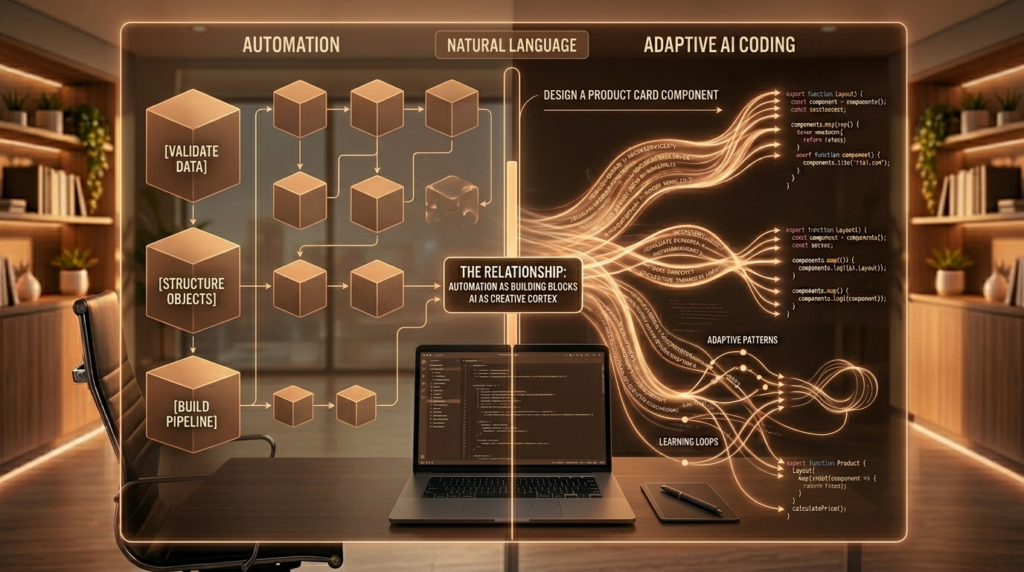
Automation works deterministically. It always produces the same outcome for a definite input. Such predictability makes it possible for developers to use automation tools to create consistent coding results.
What is AI in Coding?
AI in coding is about using intelligent systems for the coding process that detect patterns in large volumes of coding databases and repositories to produce results relevant to a given context. To develop pertinent functions, accomplishments, and entire modules, tools like Amazon CodeWhisperer, ChatGPT, and GitHub Copilot can go through natural language descriptions. Such AI systems work with machine learning models fed on billions of specimens of possible code to comprehend coding outlines, syntax, and best practices.
Unlike automation tools, the AI-powered tools are always probabilistic and adaptive. In other words, they focus on interpreting the intent and context to produce novel coding solutions instead of simply following fixed scripts. So when developers give a functional comment that describes a desired behavior, the AI coding tool can come up with the implementation. This is something that traditional automation tools can never do, as it requires a complex understanding of semantic meaning.
Key Differences
Adaptability and Flexibility
AI can come up with varied solutions. Such technologies can grasp the intent of the natural language and easily adapt based on a given context. While automation performs predetermined and repetitive workflows without any variation, it can cater to definite requirements.
Standard automation tools can’t just adjust and improvise the results to meet unexpected situations, but AI can seamlessly interpret ambiguous and complex requests to suggest several possible approaches.
Learning and Intelligence
Another factor that differentiates automation tools from AI is that automation tools cannot learn from their working and functional experience, which AI can. Automation tools always remain fixed until they are updated manually. On the other hand, AI systems are effective at continuously refining through input and training on new data. They keep learning emerging patterns and evolving coding practices. In this way, AI models trained on recent coding frameworks can offer a plethora of modern approaches, but automation scripts are not able to do that without manual revisions.